On this page
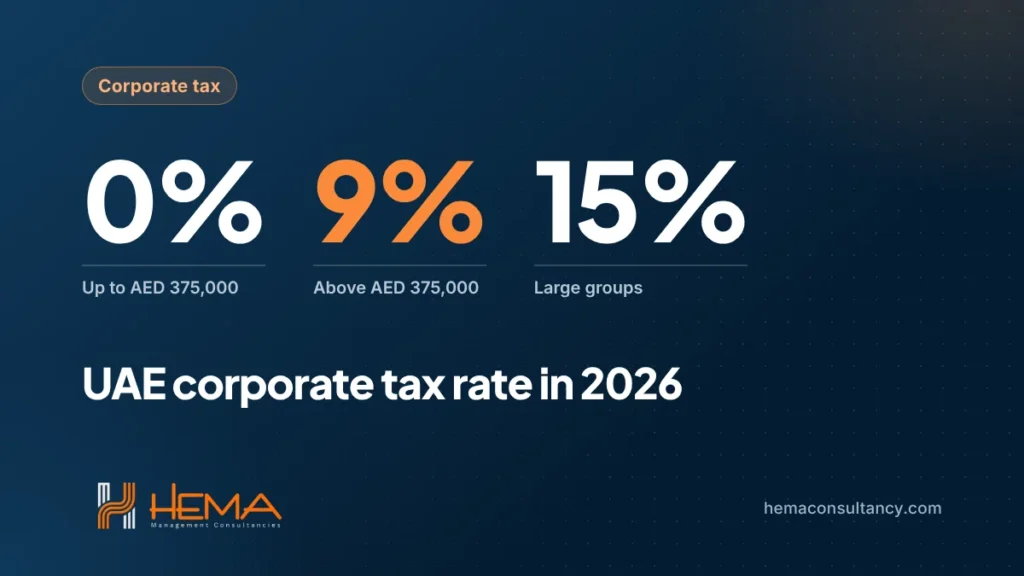
- The UAE corporate tax rate is 0% on the first AED 375,000 of taxable income and 9% on the rest.
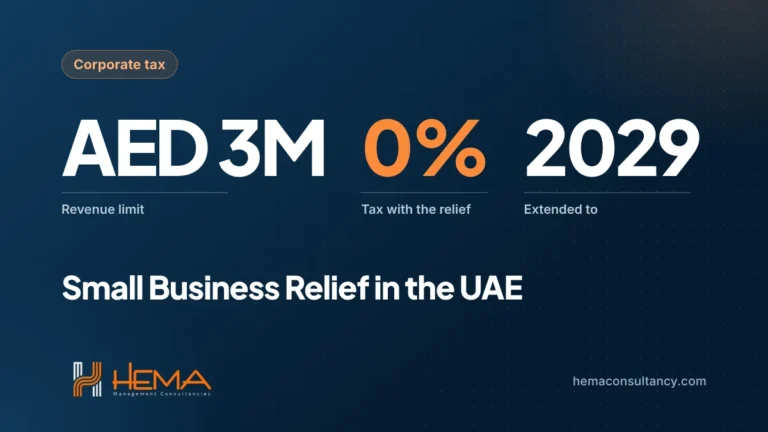
- Small Business Relief now runs to tax periods ending on or before 31 December 2029.
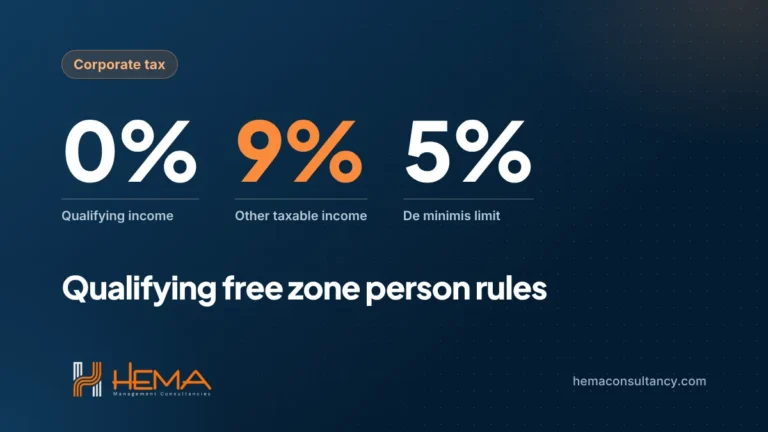
- Qualifying free zone companies pay 0% on qualifying income and 9% on everything else.
- Groups with global revenue of EUR 750 million or more pay at least 15%.
- Paying 0% does not remove the duty to register and file a return.
The UAE corporate tax rate is 9%, but most small and mid-sized businesses pay less than that, and many pay nothing at all. Corporate tax (often called company tax or business tax) applies to financial years starting on or after 1 June 2023. What you pay depends on three things: how much taxable income you make, whether you are a qualifying free zone company, and how big your group is.
Below are the rates for 2026, who pays them, and worked examples you can check against your own numbers.
What is the UAE corporate tax rate in 2026?
There are three rates. Which one applies depends on the type of business and the type of income.
| Who | Income | Rate |
|---|---|---|
| Mainland companies and other resident businesses | Taxable income up to AED 375,000 | 0% |
| Mainland companies and other resident businesses | Taxable income above AED 375,000 | 9% |
| Qualifying free zone persons | Qualifying income | 0% |
| Qualifying free zone persons | All other taxable income | 9% |
| Large multinational groups | Global revenue of EUR 750 million or more | 15% minimum |
No rate changed in 2026. What did change is the end date of Small Business Relief, which now runs to 2029 (see below).
Who pays 9% corporate tax?
The 9% rate applies only to the part of taxable income above AED 375,000. These businesses are taxed at the standard rates:
- Mainland companies, whatever their size.
- Free zone companies that do not meet the qualifying conditions, and qualifying ones on their non-qualifying income.
- Individuals running a business, such as freelancers and sole establishments, once their business turnover goes above AED 1 million in a calendar year.
- Foreign companies with a permanent establishment in the UAE, on the income linked to it.
A short list of entities can be exempt if they meet the conditions, such as government entities, qualifying public benefit organizations, and qualifying investment and pension funds. Some of them still have to register.
Corporate tax is charged on taxable income, which is your profit after tax adjustments. It is never charged on revenue or turnover.
How the AED 375,000 threshold works
The 0% band is not a cut-off. Every business taxed at the standard rates gets its first AED 375,000 of taxable income at 0%, and only the part above it is taxed at 9%. Your effective rate rises slowly and always stays below 9%.
| Taxable income | Taxed at 0% | Taxed at 9% | Corporate tax due | Effective rate |
|---|---|---|---|---|
| AED 300,000 | AED 300,000 | AED 0 | AED 0 | 0% |
| AED 500,000 | AED 375,000 | AED 125,000 | AED 11,250 | 2.25% |
| AED 1,000,000 | AED 375,000 | AED 625,000 | AED 56,250 | 5.6% |
| AED 5,000,000 | AED 375,000 | AED 4,625,000 | AED 416,250 | 8.3% |
Taxable income starts from the accounting profit in your financial statements. The law then adds back some costs: for example, only 50% of client entertainment can be deducted, and net interest costs above a set limit are capped. When we prepare your corporate tax return, we work this out line by line.
Is there a turnover limit for corporate tax?
For companies, no. Every company has to register and file a return, even with a loss or no income at all. Four amounts are often mixed up:
| Amount | What it is |
|---|---|
| AED 375,000 | Taxable income (profit) taxed at 0%. It is not a turnover limit. |
| AED 1 million | Business turnover in a calendar year above which an individual becomes subject to corporate tax. Salary, personal investments and personal property rental do not count. |
| AED 3 million | Revenue limit for Small Business Relief. |
| AED 50 million | Revenue above which a business outside a tax group must have audited financial statements for corporate tax. |
Individuals who cross AED 1 million register by 31 March of the following year. Companies set up since 1 March 2024 register within 3 months of incorporation. See corporate tax registration for the other deadlines.
Small Business Relief: extended to 2029
Resident businesses with revenue of AED 3 million or less in the tax period, and in every earlier tax period, can choose to be treated as having no taxable income. Ministerial Decision No. 131 of 2026 extended the relief to tax periods ending on or before 31 December 2029. It was due to end on 31 December 2026, and the AED 3 million limit has not changed.
- It is a choice you make in each tax return. It is not applied automatically.
- If revenue goes above AED 3 million in any period, you cannot use the relief again in later periods.
- Qualifying free zone persons cannot use it, and neither can members of multinational groups with consolidated revenue above AED 3.15 billion.
- You still register, keep records and file a return.
For who qualifies, what you give up and how to claim it, see our full guide to Small Business Relief.
Tax losses made in a year when you use the relief cannot be carried forward to later years. If you expect a loss, compare both options before you file.
Our team looks at your case and tells you what applies to you and what to do next. The first consultation is free.
Free zone companies: 0% or 9%?
A free zone license alone does not give you 0%. The company has to be a qualifying free zone person, which means it:
- keeps adequate substance (staff, premises and spending) in the free zone,
- earns qualifying income,
- keeps non-qualifying revenue within the lower of 5% of total revenue or AED 5 million,
- follows the transfer pricing rules,
- prepares audited financial statements, and
- has not chosen to be taxed at the standard rates.
If it qualifies, qualifying income is taxed at 0% and other taxable income at 9% from the first dirham. A qualifying free zone person does not get the AED 375,000 band on that income.
If a free zone company fails any condition, it is taxed at the standard rates from the start of that tax period and for the next four. That is five years at 9%.
For some small free zone businesses, the standard rules work out cheaper. Our tax advisory team can check which route fits before your first return.
The 15% rate for large groups
From financial years starting on or after 1 January 2025, UAE companies in multinational groups with consolidated global revenue of EUR 750 million or more, in at least two of the four previous years, pay a Domestic Minimum Top-up Tax. For them, the UAE corporate tax rate is effectively 15%. It does not apply to local businesses or to groups below that size.
Is corporate tax different in Dubai or Abu Dhabi?
No. Corporate tax is a federal tax, so the UAE corporate tax rate is the same in Dubai, Abu Dhabi and every other emirate, on the mainland and in free zones. It is run by the Federal Tax Authority through EmaraTax. Separate emirate taxes apply only to a few sectors, such as branches of foreign banks and some oil and gas businesses.
Other UAE tax rates at a glance
| Tax | Rate |
|---|---|
| Corporate tax | 0%, 9% or 15% (see above) |
| VAT | 5% standard rate; some supplies are zero-rated or exempt |
| Excise tax | 100% on tobacco and energy drinks; sweetened drinks are taxed by sugar content |
| Personal income tax | None on salaries |
| Withholding tax | 0% |
The VAT registration threshold is also AED 375,000, but it is measured on taxable sales, not profit. See VAT registration if you are close to it.
What follows: registration and returns
- Register for corporate tax, even if you expect to pay 0%. Late registration costs AED 10,000.
- Keep records that support your taxable income for 7 years after the end of the tax period.
- File the return and pay any tax within 9 months of the end of your tax period. A late return costs AED 500 a month for the first 12 months, then AED 1,000 a month.
Our corporate tax filing service prepares the return for you to submit and tells you exactly what to pay and by when.
Questions we hear most
The UAE corporate tax rate is 0% on the first AED 375,000 of taxable income and 9% above it. Qualifying free zone persons pay 0% on qualifying income, and large multinational groups pay at least 15%. No rate changed in 2026. Profit. The 9% is charged on taxable income, which is accounting profit after tax adjustments, and only on the part above AED 375,000. Any business taxed at the standard rates with taxable income above AED 375,000, on the part above that amount. The rate is the same in every emirate. Yes. It now covers tax periods ending on or before 31 December 2029, for resident businesses with revenue of AED 3 million or less in that period and every earlier one. Only qualifying free zone persons get 0%, and only on qualifying income. Every free zone company must still register and file a return. Yes. Registration and the annual return are required even when no tax is due, including when you choose Small Business Relief.What is the corporate tax rate in the UAE for 2026?
Is corporate tax 9% of revenue or profit?
Who pays 9% tax in Dubai?
Is Small Business Relief still available after 2026?
Do free zone companies pay corporate tax?
Do I need to register if I pay no tax?