On this page
- Mainland LLCs and joint stock companies need an audit every year under the Commercial Companies Law, whatever their size.
- Most free zones ask for audited financial statements to renew the trade license.
- For corporate tax, audited statements are required above AED 50 million of revenue, for every qualifying free zone person and for every tax group.
- The audit report must be issued by an auditor licensed by the Ministry of Economy.
- A free zone company without audited statements can lose the 0% corporate tax rate for five years.
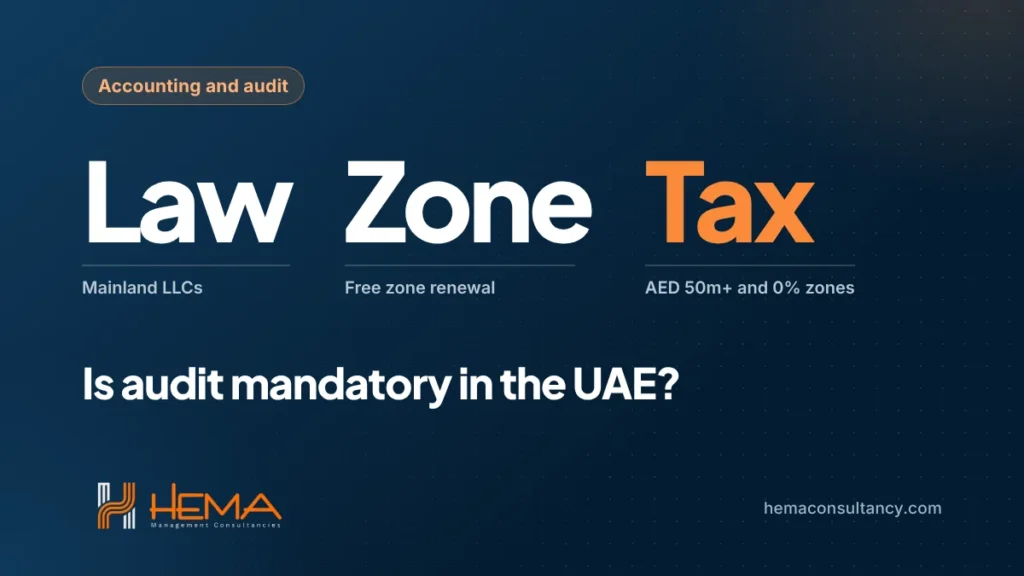
Is audit mandatory in the UAE? For most companies, yes, but not because of one rule. Three separate sets of rules can require an audit: company law, your free zone, and corporate tax. A business can fall under one, two or all three at once, so checking only the corporate tax rule gives the wrong answer for most mainland and free zone companies.
Is audit mandatory in the UAE? The short answer
| Your business | Why an audit is needed | Audit mandatory? |
|---|---|---|
| Mainland LLC or joint stock company | Commercial Companies Law, every year, whatever the size | Yes |
| Free zone company | Most free zones for license renewal; corporate tax if you want the 0% rate | Usually yes |
| Any business with revenue above AED 50 million | Corporate tax, unless it is part of a tax group | Yes |
| Tax group | Corporate tax: audited special purpose statements for the group | Yes, for the group |
| Sole establishment or civil company with revenue up to AED 50 million | No general legal rule, but banks or your licensing authority may ask | Usually no |
Mainland companies: the Commercial Companies Law
Under the Commercial Companies Law (Federal Decree-Law No. 32 of 2021), every limited liability company and joint stock company must have one or more auditors audit its accounts every year. There is no exemption for size or revenue: a small mainland LLC with a few transactions needs an audit just like a large one.
The rule covers LLCs and joint stock companies. Sole establishments and civil companies are not covered by it, although corporate tax, a bank or your licensing authority can still ask them for audited accounts.
Free zone companies: license renewal and the 0% rate
Each free zone authority sets its own rules. Most ask for audited financial statements every year to renew the trade license, and some keep a list of auditors they accept. Check your free zone's renewal checklist before your year end.
Corporate tax adds a second reason. Every qualifying free zone person must prepare audited financial statements, whatever its revenue. Without them, the company does not meet the conditions for the 0% corporate tax rate.
A free zone company that fails a qualifying condition, including the audit, is taxed at the standard rates from the start of that tax period and for the next four.
Audit requirement for corporate tax
Ministerial Decision No. 84 of 2025 sets who must prepare and keep audited financial statements for corporate tax. It applies to tax periods starting on or after 1 January 2025 and replaced Ministerial Decision No. 82 of 2023:
- Any taxable person with revenue above AED 50 million in the tax period, unless it is part of a tax group.
- Every qualifying free zone person, whatever its revenue.
- Every tax group, which prepares audited special purpose aggregated financial statements. Members of the group do not need separate audited statements for corporate tax.
For a foreign company, only the revenue of its UAE permanent establishment or UAE nexus counts toward the AED 50 million. Our financial reporting team prepares the statements that go to the auditor.
Our team looks at your case and tells you what applies to you and what to do next. The first consultation is free.
Is audit mandatory for small companies?
When people ask whether an audit is mandatory in the UAE for a small company, the answer depends on the legal form, not the size. A mainland LLC with revenue of AED 500,000 still needs a yearly audit under company law, and so does a free zone company whose authority asks for one at renewal. Below AED 50 million, corporate tax on its own does not require an audit, unless you are a qualifying free zone person.
Small businesses can keep the work lighter. For corporate tax, financial statements follow IFRS, but revenue up to AED 50 million may use IFRS for SMEs, and revenue up to AED 3 million may use cash-basis accounts (Ministerial Decision No. 114 of 2023). Up-to-date monthly books make the audit faster and cheaper.
Who can audit a company in the UAE?
The audit report must be issued by an auditor licensed by the Ministry of Economy, and free zones often keep their own lists of approved auditors. The people who keep your books cannot audit the same books.
At Hema, our audit team carries out the audit work, and your audit report is issued by a Ministry of Economy-licensed auditor. See our audit and assurance services.
When is the audit due?
| Rule | Timing |
|---|---|
| Commercial Companies Law (mainland) | Audited accounts go to the shareholders' general assembly within four months of the year end |
| Free zone license renewal | Set by each free zone; 180 days after the year end is common |
| Corporate tax | Ready for the corporate tax return, due nine months after the end of the tax period |
Start the audit as soon as your year-end books are closed. Most delays come from missing bank statements, unreconciled balances and unsupported journal entries, not from the audit itself.
What if an audit is not done?
- Mainland company: you are in breach of company law, and banks, shareholders and licensing authorities can refuse unaudited accounts.
- Free zone company: the license may not be renewed until audited statements are filed.
- Qualifying free zone person: the 0% corporate tax rate is lost for that tax period and the next four.
- Revenue above AED 50 million: you are not meeting a corporate tax requirement, which a Federal Tax Authority audit will pick up.
Questions we hear most
For most companies, yes. Mainland LLCs and joint stock companies need a yearly audit under company law, most free zones need audited statements to renew the license, and corporate tax requires them above AED 50 million of revenue, for qualifying free zone persons and for tax groups. Usually. Most free zone authorities ask for audited financial statements at license renewal, and a free zone company needs them to keep the 0% corporate tax rate as a qualifying free zone person. Only in three cases: revenue above AED 50 million (outside a tax group), qualifying free zone persons, and tax groups. Below AED 50 million, other businesses still file their corporate tax return, but corporate tax alone does not require an audit. An auditor licensed by the Ministry of Economy. Free zones may also require an auditor from their approved list. Not for most private companies. Internal audit is a management tool to test your controls. Listed companies and regulated sectors such as banks have their own requirements. It depends on the size of the business, the number of transactions and the state of your books. Clean, reconciled books cost less to audit. Your first consultation with us is free, and we quote after it. IFRS. For corporate tax, businesses with revenue up to AED 50 million may use IFRS for SMEs, and those up to AED 3 million may use cash-basis accounts.Is audit mandatory in the UAE?
Is audit mandatory for free zone companies in the UAE?
Is an audit required for corporate tax in the UAE?
Who can do an audit in the UAE?
Is internal audit mandatory in the UAE?
How much does an audit cost in the UAE?
Which accounting standards must UAE companies use?