On this page
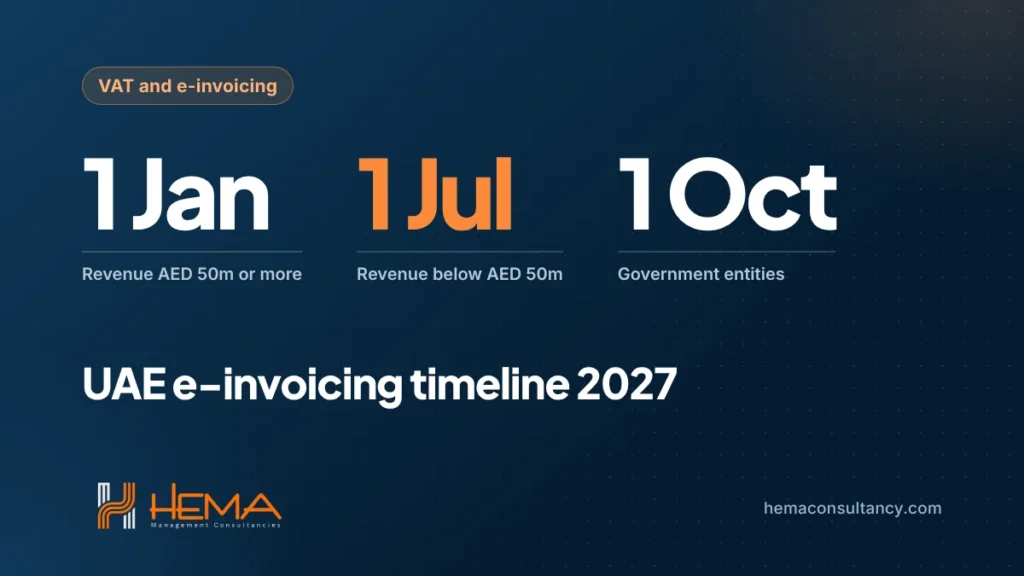
- Businesses with revenue of AED 50 million or more go live on 1 January 2027. Their deadline to appoint an accredited service provider was 30 October 2026.
- Businesses with revenue below AED 50 million must appoint a provider by 31 March 2027 and go live on 1 July 2027.
- Government entities go live on 1 October 2027.
- It covers invoices to businesses and to the government, whether or not you are VAT-registered. Sales to consumers are out of scope for now.
- Not implementing on time costs AED 5,000 a month.
The UAE e-invoicing timeline runs in three phases between January and October 2027, and the first deadline to appoint a provider has already passed. If your business sells to other businesses or to the government, you will have to issue invoices as structured electronic data through an accredited service provider, instead of sending PDFs or paper.
Below is which phase applies to you, the dates that matter, what changed in 2026, and what to do before your go-live date.
The UAE e-invoicing timeline at a glance
| Phase | Who | Appoint a provider by | Go live |
|---|---|---|---|
| Pilot and voluntary | Businesses chosen for the pilot, and anyone who opts in | Before starting | From 1 July 2026 |
| Phase 1 | Revenue of AED 50 million or more | 30 October 2026 (passed) | 1 January 2027 |
| Phase 2 | Revenue below AED 50 million | 31 March 2027 | 1 July 2027 |
| Phase 3 | Government entities | 31 March 2027 | 1 October 2027 |
The dates come from Ministerial Decision No. 244 of 2025, as amended in 2026. The provider you appoint must be on the Ministry of Finance list of accredited service providers.
Was the e-invoicing deadline extended?
Only one date moved. In May 2026, Ministerial Decision No. 66 of 2026 gave businesses with revenue of AED 50 million or more until 30 October 2026, instead of 31 July 2026, to appoint an accredited service provider. Their go-live date did not change: it is still 1 January 2027. The rest of the UAE e-invoicing timeline, for smaller businesses and government entities, has not changed either.
A second amendment, Ministerial Decision No. 197 of 2026, took effect on 1 October 2026. It did not move any go-live date, but it changed some of the day-to-day rules (see "What changed in October 2026" below).
Which phase is your business in?
Your phase depends on revenue: the gross income of your most recent accounting period, based on your financial statements, or other documents the Federal Tax Authority accepts if you have none.
- Count all revenue, including sales to consumers, even though those sales do not need e-invoices yet.
- Revenue of AED 50 million or more: phase 1, live from 1 January 2027.
- Revenue below AED 50 million: phase 2, live from 1 July 2027.
- Government entities follow their own date, whatever their size.
The 30 October 2026 deadline has passed, but the 1 January 2027 go-live date still applies. Appoint a provider now and leave time to connect and test your system.
Is e-invoicing mandatory for small businesses?
Yes. There is no minimum size: the rules apply to any person doing business in the UAE, unless the transaction is excluded. Businesses with revenue below AED 50 million are in phase 2, so they appoint a provider by 31 March 2027 and go live on 1 July 2027.
- VAT registration is not a condition. A business that is not registered for VAT needs a tax identification number (TIN) from the Federal Tax Authority to use the system.
- Buyers need a provider too. Your suppliers will send their e-invoices to you through the network, and you receive them through your own provider.
- Starting early is allowed. Any business can join voluntarily before its phase, and penalties only apply from its mandatory date.
What is excluded from e-invoicing?
- Sales to consumers (B2C), until further notice.
- Sovereign activities of government entities that do not compete with the private sector.
- International passenger flights sold with an electronic ticket, and related airline services.
- International air cargo shipped with an airway bill, for 24 months from 1 January 2027.
- Financial services that are VAT-exempt or zero-rated.
- Transactions between members of the same tax group, for 24 months from 1 January 2027.
If most of your sales are excluded but some are not, the rest still need e-invoices.
Our team looks at your case and tells you what applies to you and what to do next. The first consultation is free.
How UAE e-invoicing works
E-invoicing replaces PDF and paper invoices for business sales with structured data that travels over a network called Peppol, in the UAE format known as PINT AE.
- Your accounting or ERP system creates the invoice data.
- Your accredited service provider checks it and sends it to your customer's provider.
- Your customer's provider delivers it into your customer's system.
- The providers report the tax data to the Federal Tax Authority in near real time.
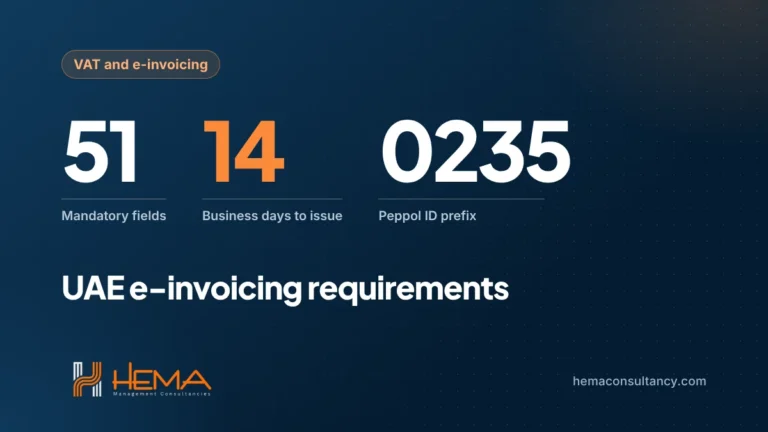
Each e-invoice must be issued and sent within 14 business days of the transaction. A sent e-invoice cannot be edited or deleted: to correct it, you issue an electronic credit note that refers to it.
For the data fields, your Peppol ID and a full checklist, see our guide to UAE e-invoicing requirements.
What changed in October 2026
Ministerial Decision No. 197 of 2026 took effect on 1 October 2026 and eased some of the original rules:
- The time limit to issue an e-invoice is now 14 business days, instead of 14 calendar days.
- Businesses no longer have to tell the Federal Tax Authority when their e-invoicing system fails.
- Transactions between members of the same tax group are excluded for the first 24 months.
- The rule on where e-invoice records are stored was relaxed.
Penalties for missing the deadline
| What went wrong | Penalty |
|---|---|
| Not appointing a provider or not implementing e-invoicing on time | AED 5,000 for each month |
| An e-invoice not issued or sent on time | AED 100 per invoice, up to AED 5,000 a month |
| An electronic credit note not issued or sent on time | AED 100 per credit note, up to AED 5,000 a month |
The penalties are set by Cabinet Decision No. 106 of 2025. They do not apply to businesses that join voluntarily before their mandatory date.
What to do before your go-live date
Work back from your date in the UAE e-invoicing timeline and leave time for testing:
- Confirm your phase from your latest financial statements.
- Clean up your customer data: each business customer needs a valid TIN or VAT number, and your system must produce every field the UAE format requires.
- Choose an accredited service provider from the Ministry of Finance list and onboard through EmaraTax.
- Connect and test your accounting or ERP system with real invoices and credit notes.
- Train your team on credit notes and the 14-business-day limit.
- Go live on your date and keep your records.
Our e-invoicing setup team does the readiness check, data clean-up, provider selection and testing with you, so you are ready before your date.
Questions we hear most
Voluntary use has been open since 1 July 2026. Under the UAE e-invoicing timeline, it becomes mandatory on 1 January 2027 for businesses with revenue of AED 50 million or more, on 1 July 2027 for businesses below AED 50 million, and on 1 October 2027 for government entities. Only the deadline to appoint a provider for businesses with revenue of AED 50 million or more moved, from 31 July to 30 October 2026. All go-live dates are unchanged. Yes, for invoices to businesses and to the government, whatever the size of your business, once your phase starts. Sales to consumers are not covered for now. Yes. VAT registration is not a condition. A business without a VAT number needs a tax identification number (TIN) from the Federal Tax Authority. 14 business days from the date of the transaction, since 1 October 2026. Before that, the limit was 14 calendar days. Not appointing a provider or not implementing on time costs AED 5,000 a month. Each e-invoice or credit note not issued on time costs AED 100, up to AED 5,000 a month.When does e-invoicing start in the UAE?
Is the UAE e-invoicing deadline extended?
Is e-invoicing mandatory in the UAE?
Do I need e-invoicing if I am not VAT-registered?
How long do I have to issue an e-invoice?
What happens if I miss my e-invoicing deadline?