On this page
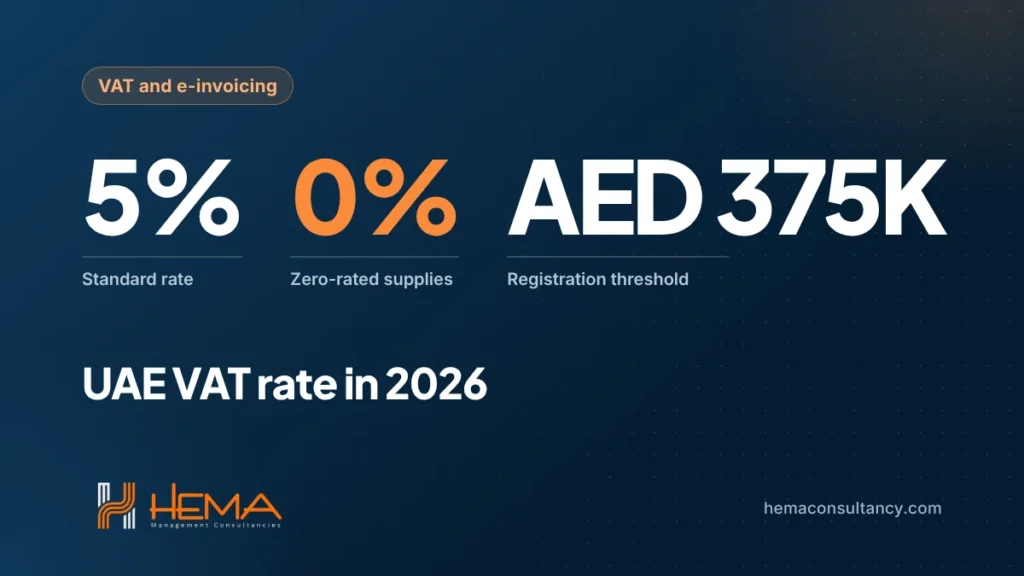
- The UAE VAT rate is 5%, the same in Dubai, Abu Dhabi and every other emirate. It has not changed since VAT started on 1 January 2018.
- Some supplies are zero-rated (0%): exports, international transport, certain education and healthcare, the first supply of new homes and investment gold.
- Some are exempt (no VAT): residential rent and resale, bare land, local passenger transport and certain financial services.
- The VAT changes of 1 January 2026 changed procedures, not the rate.
- You must register once your taxable supplies and imports pass AED 375,000 in 12 months.
The UAE VAT rate is 5%, one of the lowest in the world, and it applies to most goods and services. But not every sale is charged at 5%. Some are zero-rated, some are exempt and some are outside the scope of VAT, and the difference decides both what you charge and what VAT you can recover on your costs.
Below is how each rate works, what falls where, how to work out VAT on a price, and what changed in 2026.
What is the VAT rate in the UAE?
| Treatment | Rate | Recover VAT on your costs? | Counts toward registration? |
|---|---|---|---|
| Standard-rated | 5% | Yes | Yes |
| Zero-rated | 0% | Yes | Yes |
| Exempt | No VAT | No | No |
| Outside the scope | No VAT | Depends on the supply | No |
VAT is a federal tax, so the UAE VAT rate is the same in all seven emirates: Abu Dhabi, Dubai, Sharjah, Ajman, Umm Al Quwain, Ras Al Khaimah and Fujairah. So the VAT percentage in Dubai and in Abu Dhabi is the same: 5%. The rules sit in Federal Decree-Law No. 8 of 2017 on VAT and its Executive Regulation, and the Federal Tax Authority (FTA) runs the system.
Is the UAE VAT rate changing in 2026?
No. Federal Decree-Law No. 16 of 2025 amended the VAT Law from 1 January 2026, but it kept the rate at 5% and did not change the zero-rated or exempt lists. Some websites have claimed a higher rate is coming; no such change has been announced as of November 2026.
What did change from 1 January 2026:
- Reverse charge: you no longer issue a self-invoice when you account for VAT on imported services under the reverse charge. You keep the supplier’s invoice and supporting documents instead.
- Refunds and credits: excess VAT credits must be claimed within five years, with a transition period for older balances.
- Input tax: the FTA can refuse recovery of VAT on a purchase linked to tax evasion that the business knew, or should have known, about.
- Time limits: audit and assessment time limits now come only from the Tax Procedures Law.
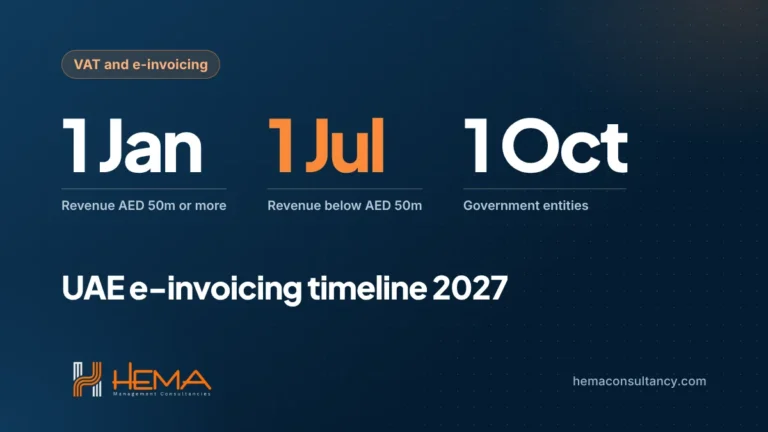
The next big change is e-invoicing, which becomes mandatory in phases from 1 January 2027. See the UAE e-invoicing timeline.
Zero-rated supplies (0%)
Zero-rated supplies are taxable, but at 0%. You charge no VAT, you still report the sale in your VAT return, and you can recover the VAT on related costs. The main ones:
- Exports of goods outside the UAE, and many services supplied to customers abroad, when the conditions are met.
- International transport of passengers and goods, and related services.
- Certain means of transport, such as aircraft, ships and trains, and related goods and services.
- Investment gold, silver and platinum of 99% purity or more.
- The first sale or lease of a new residential building within three years of completion, and the first supply of a building converted to residential use or built for a charity.
- Certain education services from recognized nurseries, schools and higher education institutions, and related goods and services.
- Preventive and basic healthcare services, and certain medicines and medical equipment.
- Crude oil and natural gas.
Keep official proof that goods left the UAE, such as customs export documents, and proof that a service customer is outside the UAE. Without it, the FTA can treat the sale as taxable at 5%.
Exempt supplies (no VAT)
Exempt supplies carry no VAT, but you cannot recover the VAT on the costs that relate to them. The main ones:
- Certain financial services where no explicit fee is charged, such as interest on loans, and life insurance.
- Management of investment funds, and the transfer and conversion of virtual assets, exempt since 15 November 2024.
- Residential buildings after the first zero-rated supply, so most residential rent and resales.
- Bare land.
- Local passenger transport.
A business that makes only exempt supplies cannot register for VAT. One that makes both taxable and exempt supplies recovers its VAT on shared costs in proportion.
Our team looks at your case and tells you what applies to you and what to do next. The first consultation is free.
How to work out VAT at 5%
| You have | Formula | Example |
|---|---|---|
| A price before VAT | Price x 5% | AED 1,000 x 5% = AED 50 VAT, so AED 1,050 in total |
| A price including VAT | Price ÷ 21 | AED 1,050 ÷ 21 = AED 50 VAT |
| A price including VAT, and you want the net price | Price ÷ 1.05 | AED 1,050 ÷ 1.05 = AED 1,000 |
Prices you show to consumers must include VAT. A tax invoice must show the VAT amount in AED, even when you invoice in another currency.
VAT for free zone companies
A free zone license does not change the VAT rate. For VAT, most free zones are treated exactly like the mainland, so 5% applies.
- Designated zones: some free zones are designated zones for VAT. Goods moving within or between designated zones can be outside the scope of VAT when the conditions are met.
- Services: services supplied in a designated zone are generally taxed at 5%.
- Goods leaving for the mainland: these are treated as imports, so VAT applies.
The 0% corporate tax rate for free zone companies is a separate regime with its own conditions. See qualifying free zone person rules.
When you must register and charge VAT
| Registration | When it applies |
|---|---|
| Mandatory | Taxable supplies and imports above AED 375,000 in the last 12 months, or expected to pass it in the next 30 days. Apply within 30 days. |
| Voluntary | Taxable supplies and imports, or taxable expenses, above AED 187,500. |
Zero-rated sales count toward the threshold; exempt sales do not. Once registered, you charge VAT at the right rate, issue tax invoices and file VAT returns, usually every quarter, by the 28th day after the period ends.
Our VAT registration team checks whether and when you must register and prepares your application for you to review and submit. For returns, see VAT return filing.
Questions we hear most
The standard UAE VAT rate is 5%. It has applied since VAT started on 1 January 2018. Some supplies are zero-rated at 0%, and some are exempt. Yes. VAT is a federal tax, so the rate is 5% in Dubai, Abu Dhabi and every other emirate. No. The VAT Law changes that took effect on 1 January 2026 kept the rate at 5% and did not change the zero-rated or exempt lists. No rate increase has been announced as of November 2026. A zero-rated supply is taxable at 0%. You charge no VAT but can still recover the VAT on related costs. Examples include exports, international transport, certain education and healthcare, and the first supply of new residential buildings. Both mean no VAT on the sale. With a zero-rated supply you can recover VAT on related costs and the sale counts toward the registration threshold. With an exempt supply you cannot recover that VAT, and the sale does not count. Yes. Most free zones are treated like the mainland for VAT, so 5% applies. Some goods moving within or between designated zones can be outside the scope of VAT, but services there are generally taxed at 5%.What is the VAT rate in the UAE?
Is VAT 5% in Dubai and Abu Dhabi?
Is the UAE VAT rate increasing in 2026?
What is zero-rated VAT in the UAE?
What is the difference between zero-rated and exempt?
Do free zone companies pay VAT?